
A Month and a Half: Building Consumer Healthcare and Referral Operations
One FDE, a month and a half: products, billing, referrals, follow-up, and service delivery connected across five interfaces at a rehabilitation hospital.
On this page8 sections
Two businesses conventional hospital systems cannot accommodate
One FDE (Forward Deployed Engineer) spent a month and a half connecting products, billing, referrals, follow-up, and service delivery for consumer healthcare at a rehabilitation hospital. The system covers business outside conventional clinical and medical-insurance systems: independently priced service packages, large prepaid balances, referral-agent compensation, and ongoing customer journeys.
- Consumer healthcare on a VIP floor: a dedicated floor and operations team serve higher-end customers with genetic testing, health management, nutritional products, and similar offerings. Many sit outside the medical-insurance benefit catalogue, with substantial service fees and independent pricing.
- Referrals from insurance agents: local life and property insurance agents already have customer relationships. For example, a customer with a fracture after a road accident may need an insurance claim and rehabilitation. An agent refers that person to the hospital, receives points or a service fee, and the customer receives benefits such as expedited access or VIP services.
The previous process relied on Excel and manual bookkeeping. The hardest problem was that the package price was fixed while clinical costs varied at each visit. Suppose a package has five installments of about RMB 8,000 each. If one installment incurs RMB 2,000 in drugs and examinations recorded in the hospital information system (HIS), how should the remaining RMB 6,000 be recorded as a service fee and scheduled? Conventional systems add individually priced items together; they cannot work backward from a fixed package total. The new system accepts the actual HIS cost at execution, automatically assigns the remainder to service fees, and schedules the service.
| Dimension | Conventional clinical care (HIS / medical insurance) | What this system adds |
|---|---|---|
| Pricing | Catalogue prices, added item by item | Independent prices; service fees calculated from a fixed package total |
| Payment | Medical insurance plus out-of-pocket payment | Prepaid balances, points, WeChat Pay, and other methods |
| Acquisition | Patients arrive directly | Seminars, referral agents, and partner organizations |
| Follow-up | The encounter ends with the visit | Tracking from booking and callbacks through arrival and conversion |
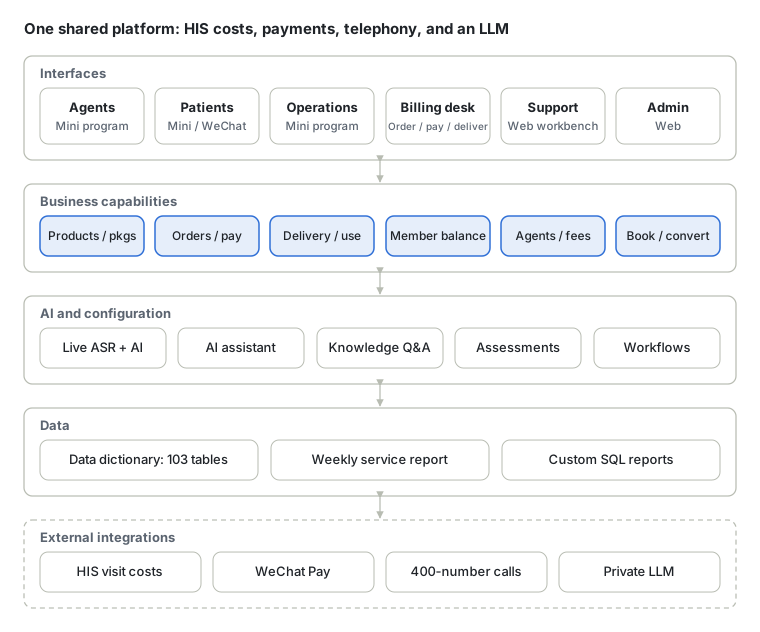
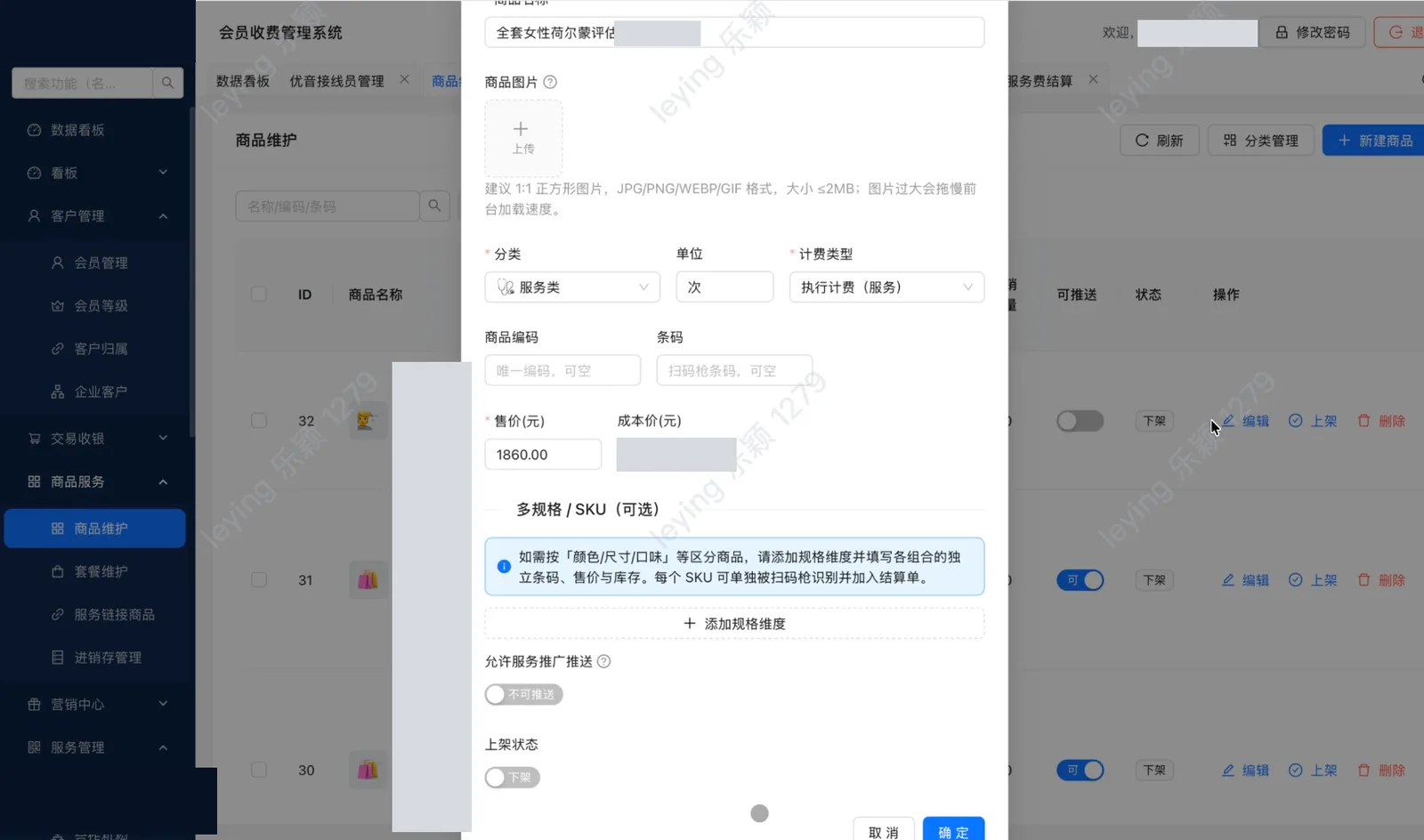
Screenshots come from demonstration environments and actual business interfaces. Hospital names, staff and customer names, phone numbers, accounts, and internal addresses have been removed. Business figures reflect screens or statements from the October 23, 2026 demonstration and are not audited operating results. Product screenshots retain their original Chinese interface; captions and the two explanatory diagrams are provided in English.
Business management: from what is sold to what is delivered
The system separates what to sell, how to charge, who collects payment, and who delivers the service into four stages, each with its own interface and role.
- Products and packages: categories include physical goods, services, genetic tests, and assessment questionnaires. Each product can have a selling price, cost, stock alert, and two important settings: whether it may be promoted to customers, and when it is charged. Goods are charged when sold; services are charged when performed.
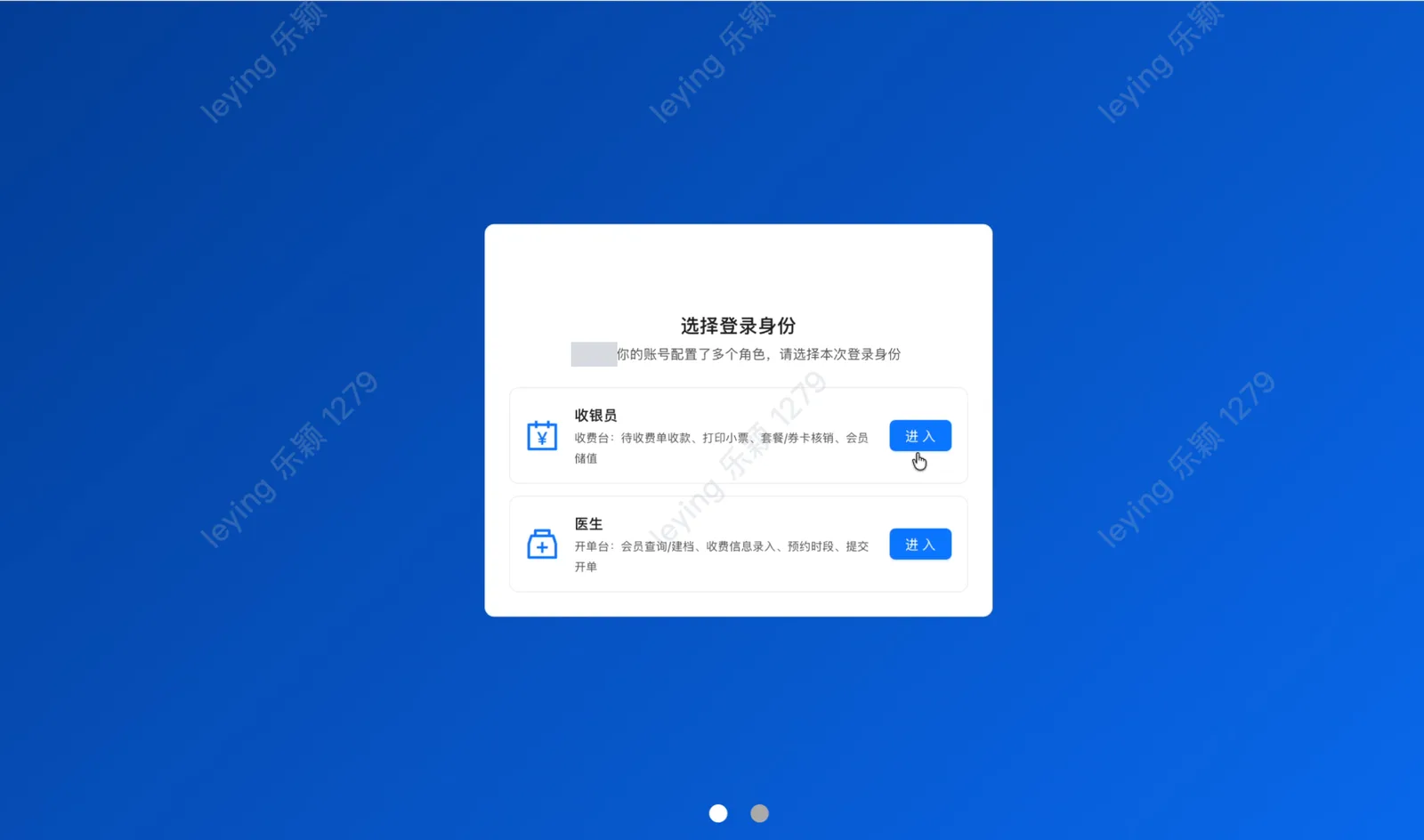
- Order entry and payment collection are separate: a doctor’s order creates an unpaid order; a cashier collects the payment. One account can hold multiple roles, with the user choosing a role at login.
- Execution and redemption: the technician’s workbench records the appointment, operator, duration, and actual cost. Packages show redemption progress, and appointments are linked to technician schedules.
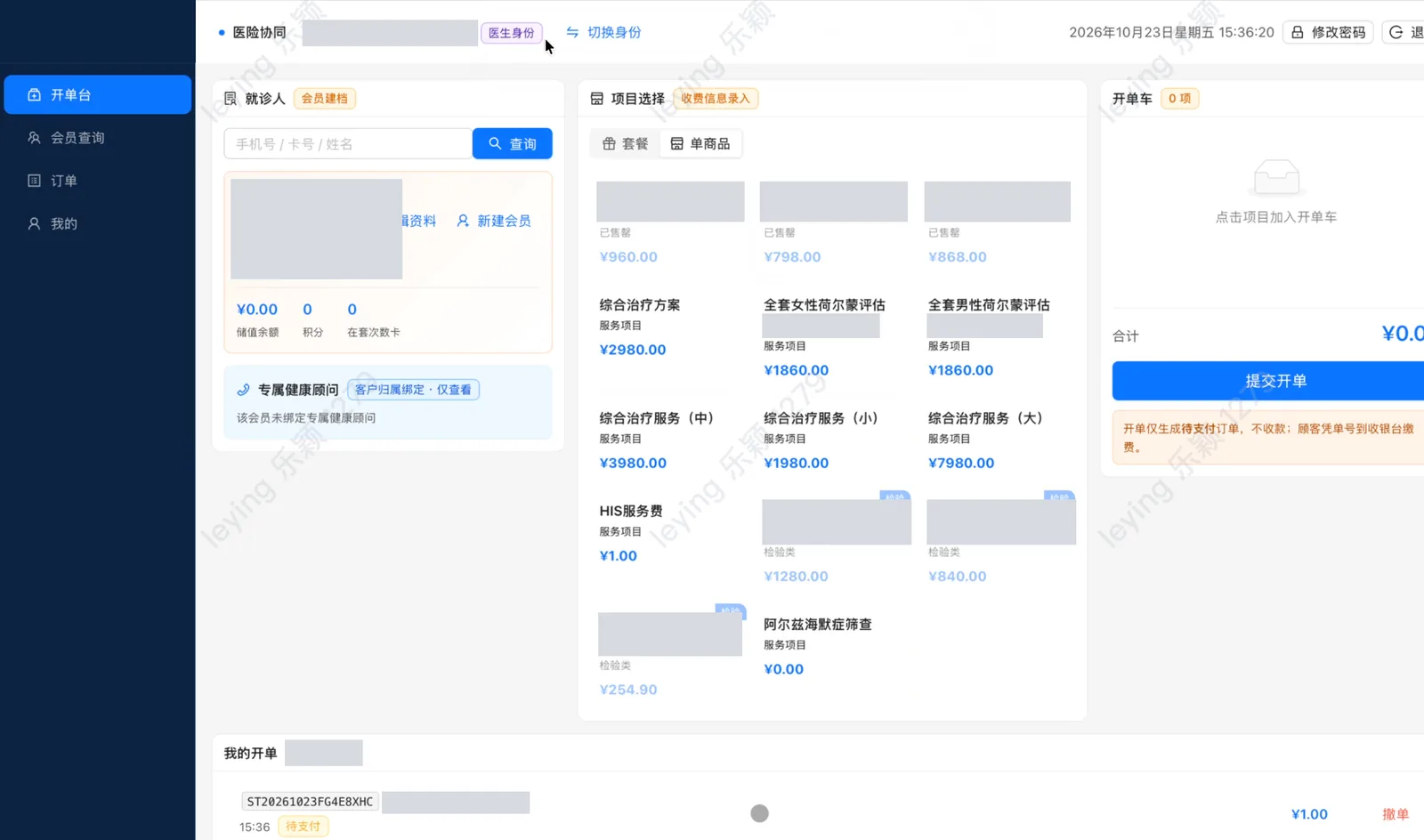
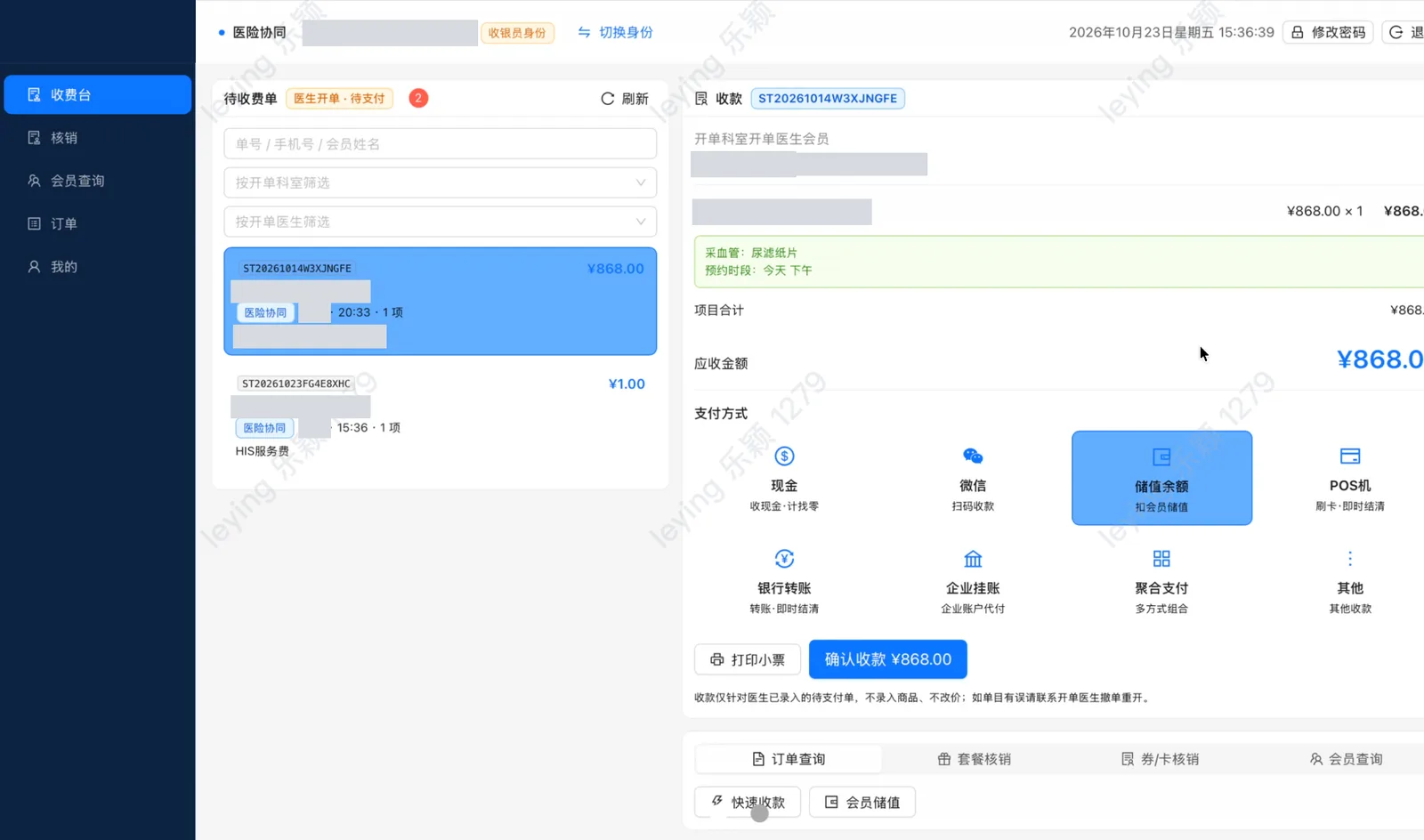
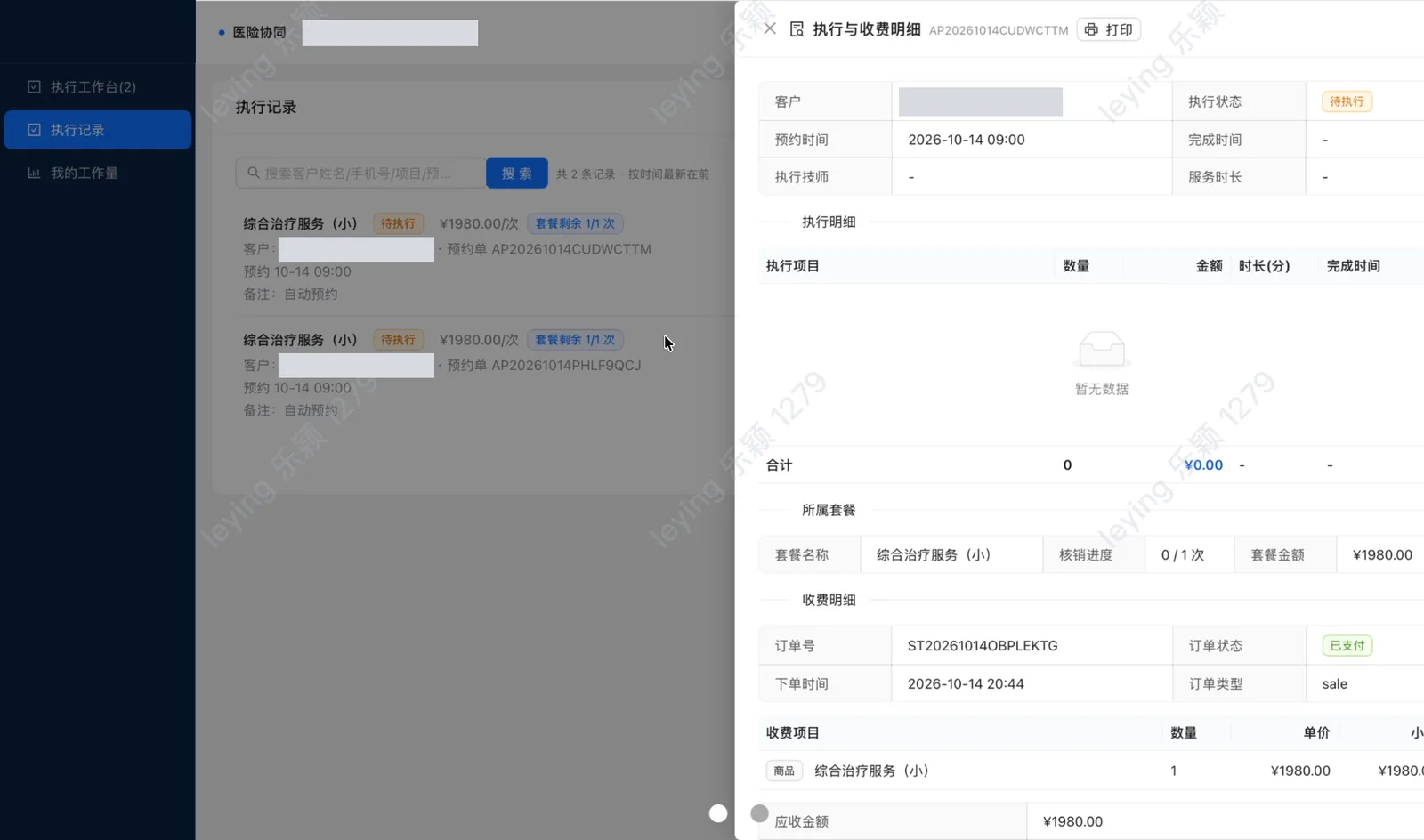
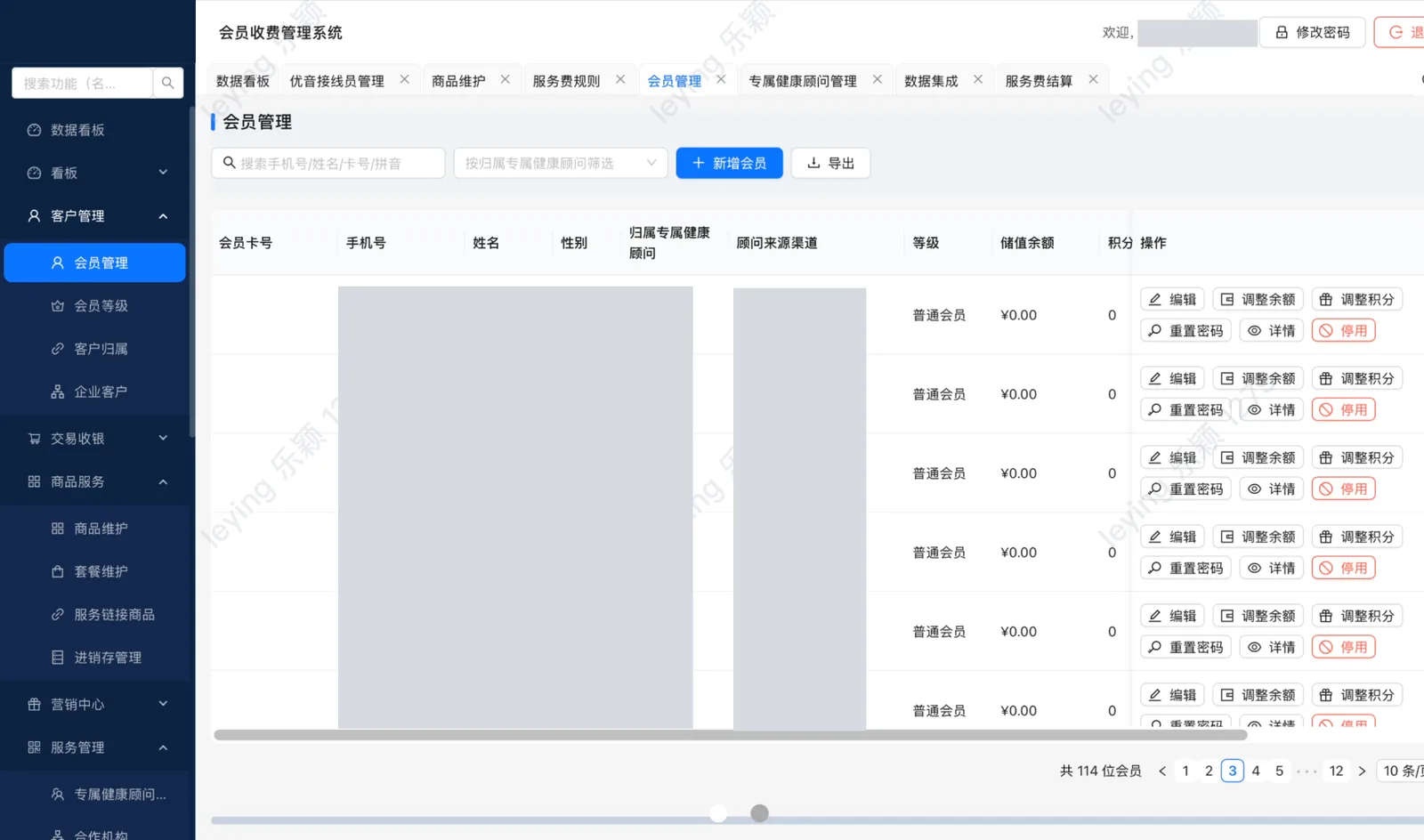
Membership is the account at the center of the system. A member has a prepaid balance, points, multi-visit passes, benefits, and an assigned personal health advisor. Prepaid balances replace manual bookkeeping for customers making large purchases on the VIP floor: a customer may deposit tens of thousands of renminbi, place orders following a doctor’s recommendations, and have the balance deducted when services are performed. Points have two uses: cash withdrawal or hospital benefits priced at roughly half the equivalent cash price, encouraging further spending within the hospital. Prescription-related items cannot be redeemed with points; benefit packages are still being designed.
Referral agents and channels: tracing every customer’s source
The central design makes customer acquisition a complete chain from the operations staff member to the customer, with compensation calculated from that chain.
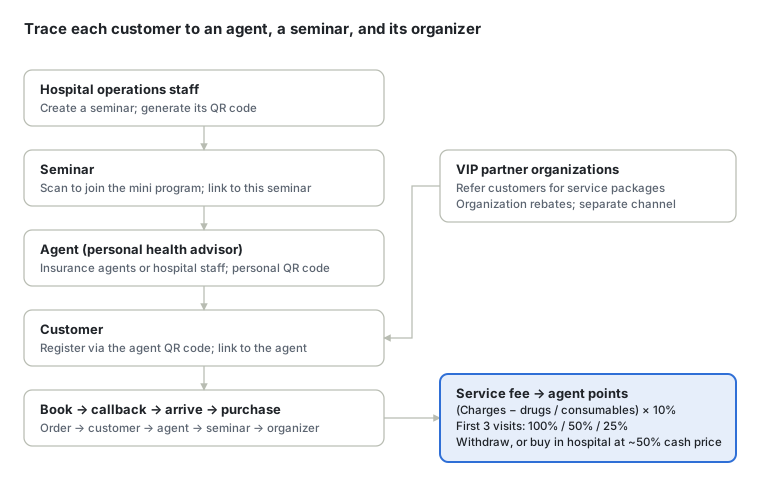
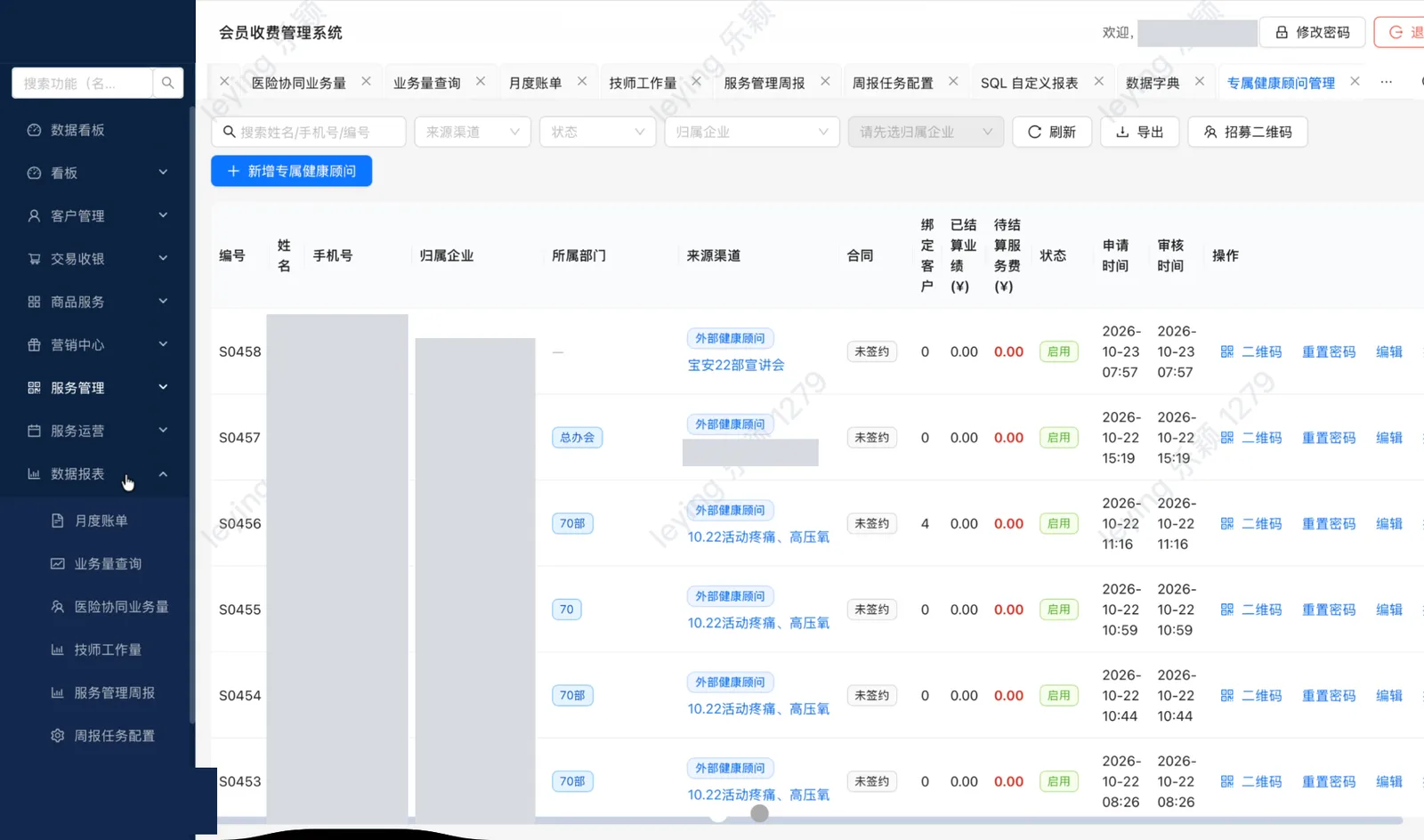
- Two channels are managed separately: the agent channel includes life and property insurance agents and hospital employees registered as agents, called “personal health advisors” in the system. The partner-organization channel consists of two organizations serving the VIP floor. They recommend service packages to higher-end customers and receive organization-level rebates, independently of agent commissions.
- Seminars are the starting point for acquisition: operations staff create a seminar, and the system generates its QR code. Agents scan it to join the mini program and become linked to that seminar and its organizer. Each agent then recruits customers using a personal QR code; scanning customers become linked to that agent.
- Allocation rules: the service fee equals (total outpatient or inpatient charges − drugs and consumables) × 10%. For the same customer’s first, second, and third visits, the agent receives 100%, 50%, and 25% of that service fee. These percentages apply to the service fee, not the full bill: for RMB 1,000 in spending with no drug or consumable costs, the three amounts would be RMB 100, RMB 50, and RMB 25. The declining share encourages agents to keep acquiring new customers.
- Restrained incentives: a proposal to pay RMB 10 per newly registered customer was dropped because fictitious customers could exploit it. Cooperation contracts with each agent are planned; an electronic-contract entry already exists in the system.
Five interfaces, each responsible for a stage
The same data supports five role-based interfaces. Hospital billing is further divided into order-entry, cashier, and execution workbenches.
| Interface | Users | Main capabilities | Format |
|---|---|---|---|
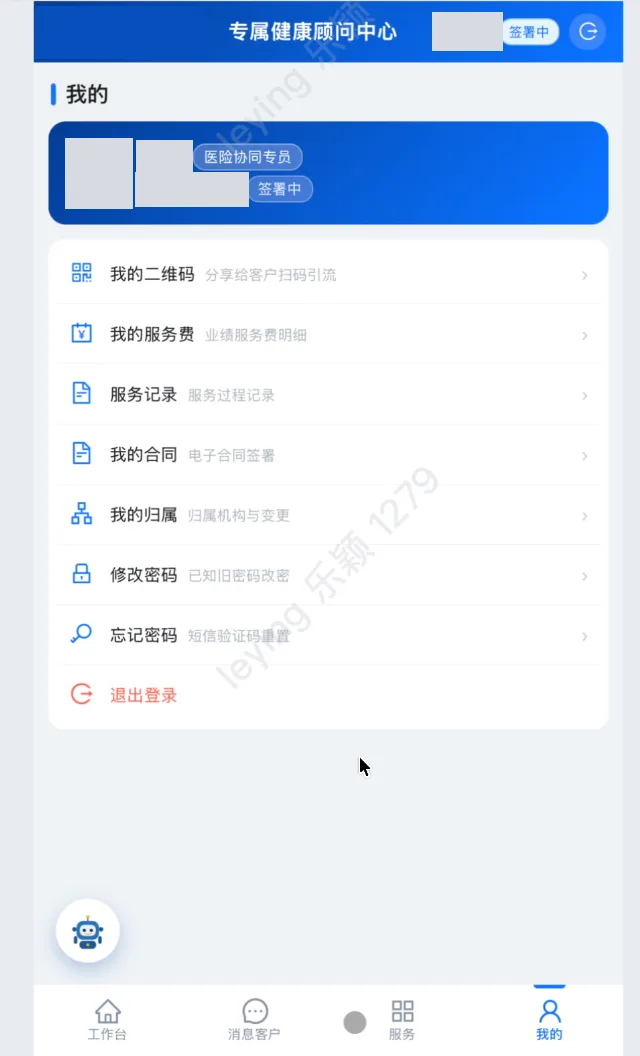
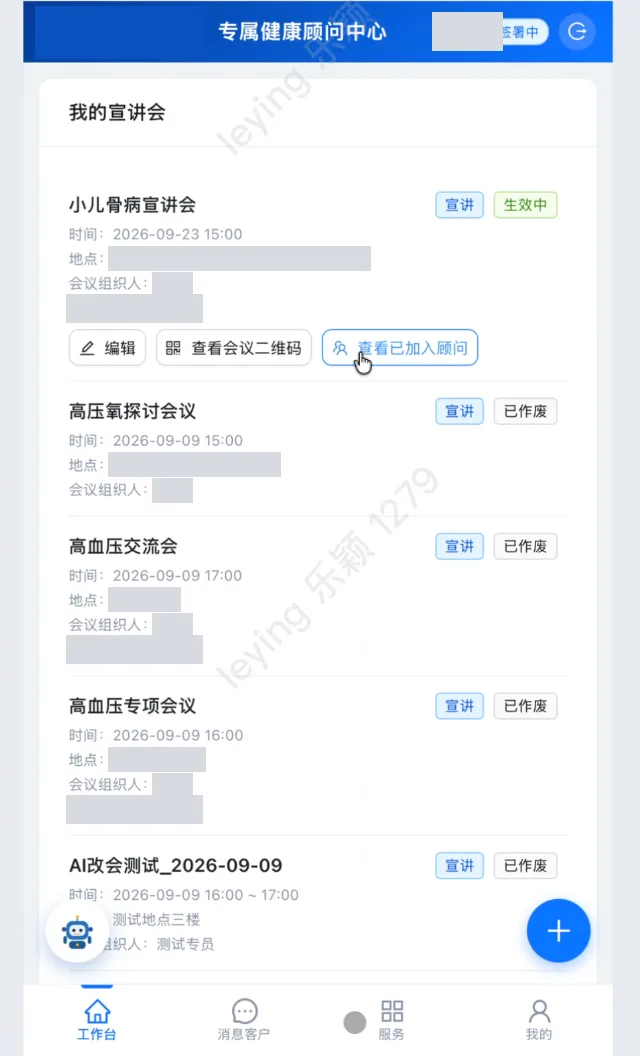
| Agent | Insurance agents and hospital employees registered as agents | Personal QR code, customers, service fees, service records, electronic contracts, booking on a customer’s behalf, messaging, and product recommendations | Mini program |
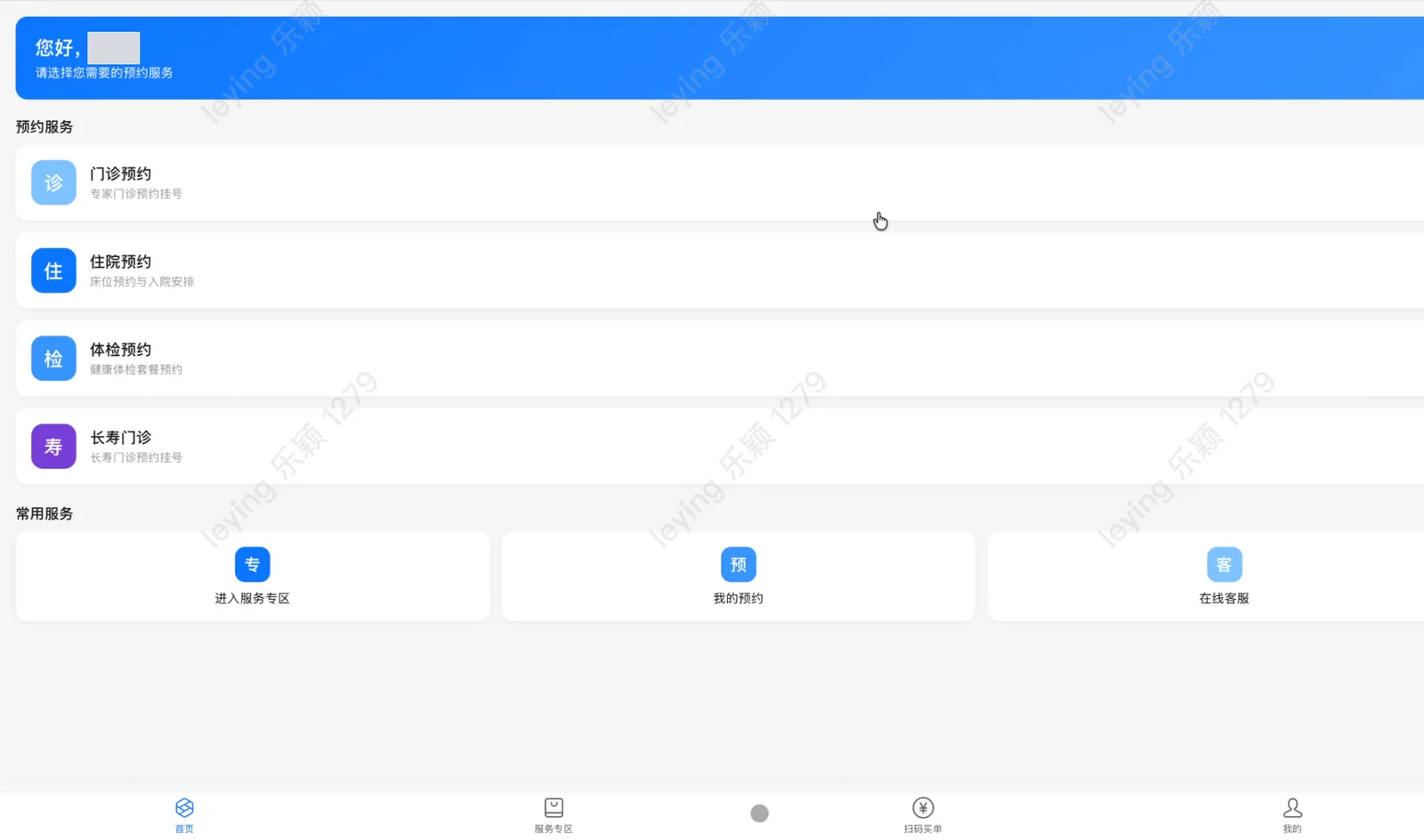
| Patient / consumer | Customers | Outpatient, inpatient, checkup, and longevity-clinic bookings; service area; online support; assessment questionnaires | Mini program / WeChat service account |
| Hospital operations | Hospital operations staff | Seminars, agent onboarding review, and reports, with greater permissions than ordinary agents | The same mini program, with role-based views |
| Customer service | Service-center staff | Booking tickets, outbound calls, live transcription, AI prompts, and conversion tracking | Web workbench |
| Administration | Management and operations staff | Products, members, advisors, benefits, reports, questionnaires, business workflows, and model configuration | Web administration |

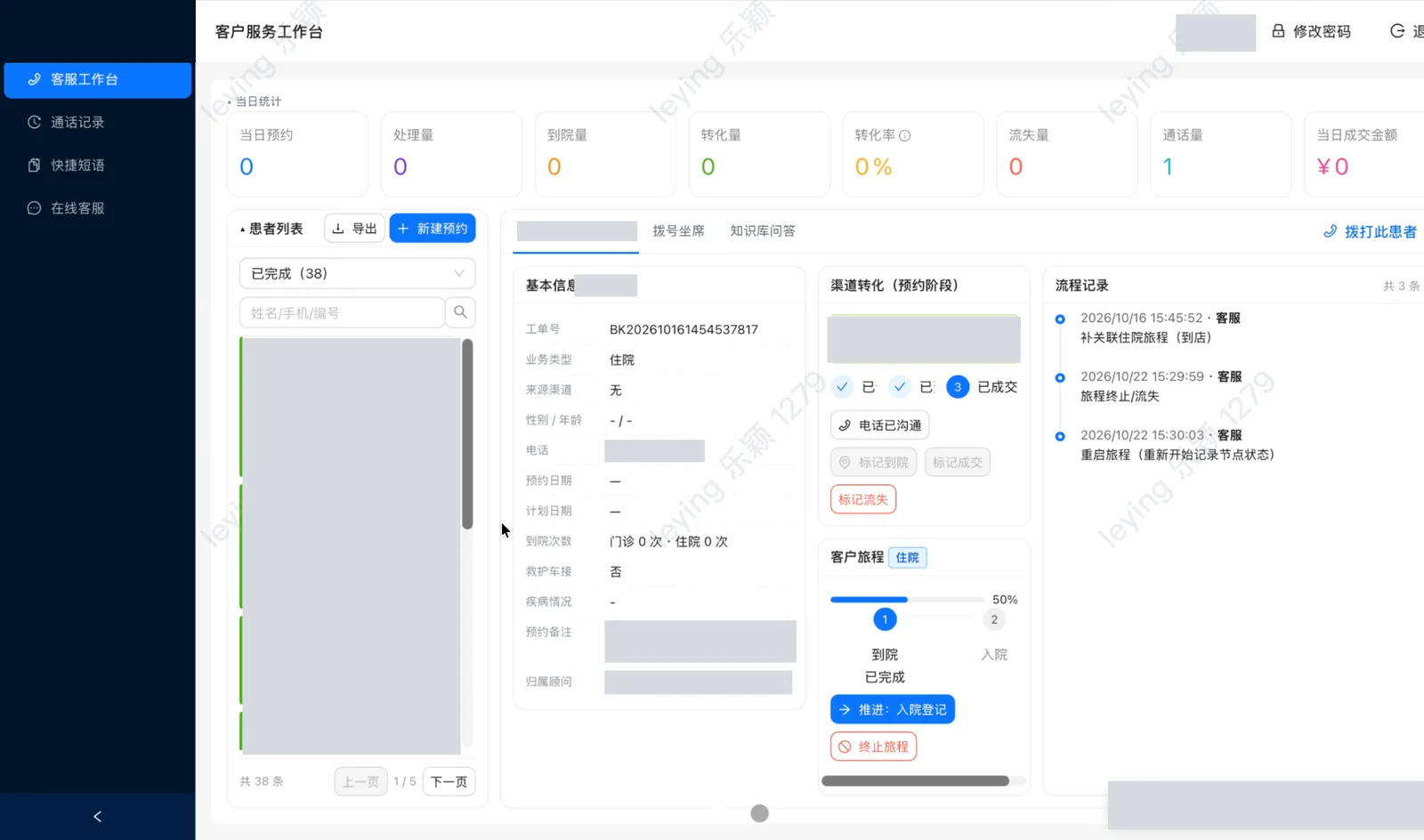
Customer service follows each booking through to arrival. Bookings from agents or consumers enter the customer-service task list. Staff call back, record the chief complaint, and advance workflow steps; arrival at the hospital counts as a real conversion. The top of the workbench shows the day’s bookings, handled cases, arrivals, conversions, conversion rate, lost customers, calls, and transaction value. Each ticket also has a customer journey, such as arrival → admission for inpatient care.
AI and configuration: letting the business adjust its own system
AI supports specific frontline tasks. Questionnaires, business workflows, and reports are configurable so that changing a rule does not always require changing code.
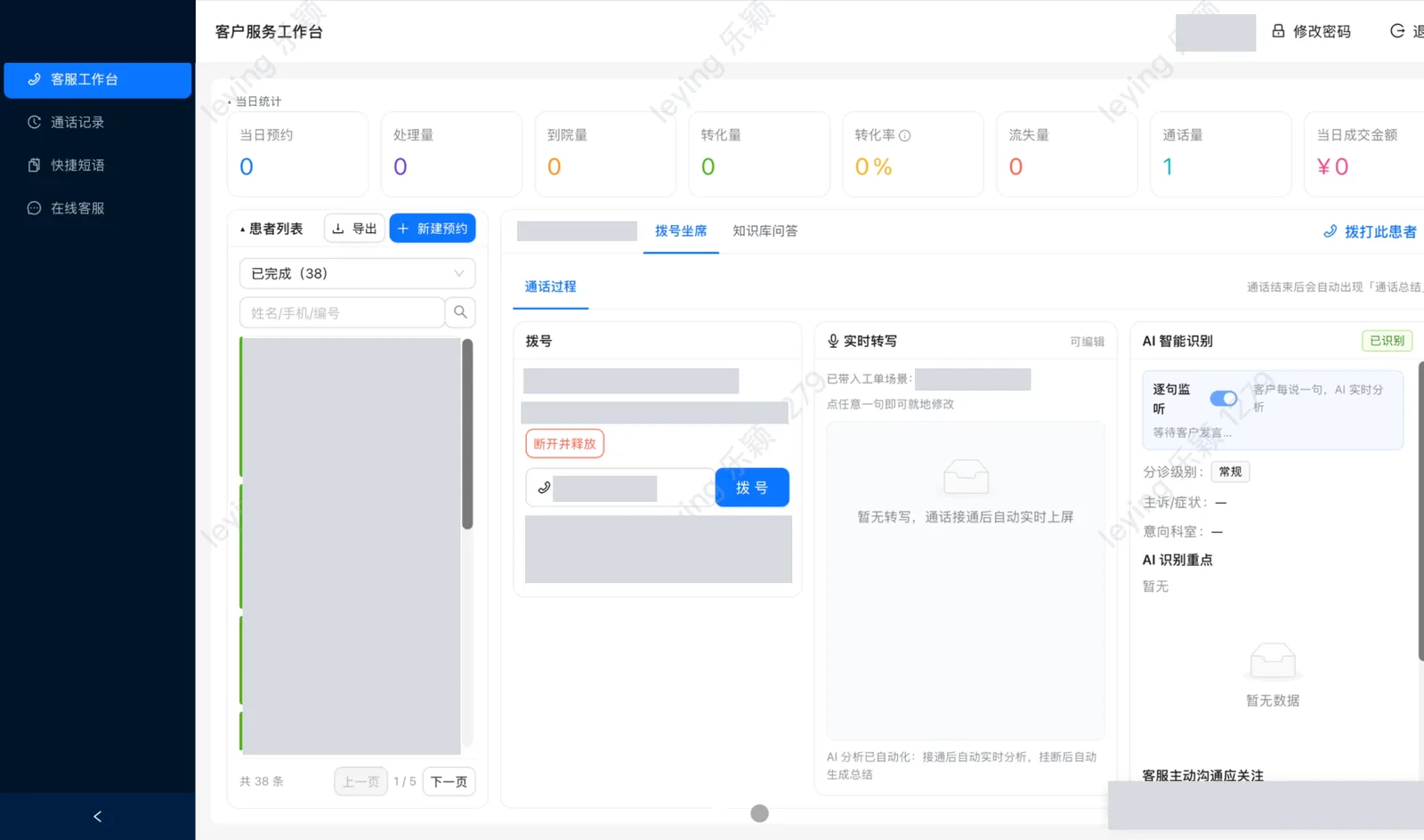
- Call-center support: a WebSocket connection supplies audio from the 400-number call-center system for live transcription. A privately deployed large language model suggests triage level, chief complaint, intended department, and points for the next exchange, then produces a summary after the call. These prompts assist communication and are not diagnostic or treatment advice. The customer-service interface is still undergoing technical debugging and has not formally launched.
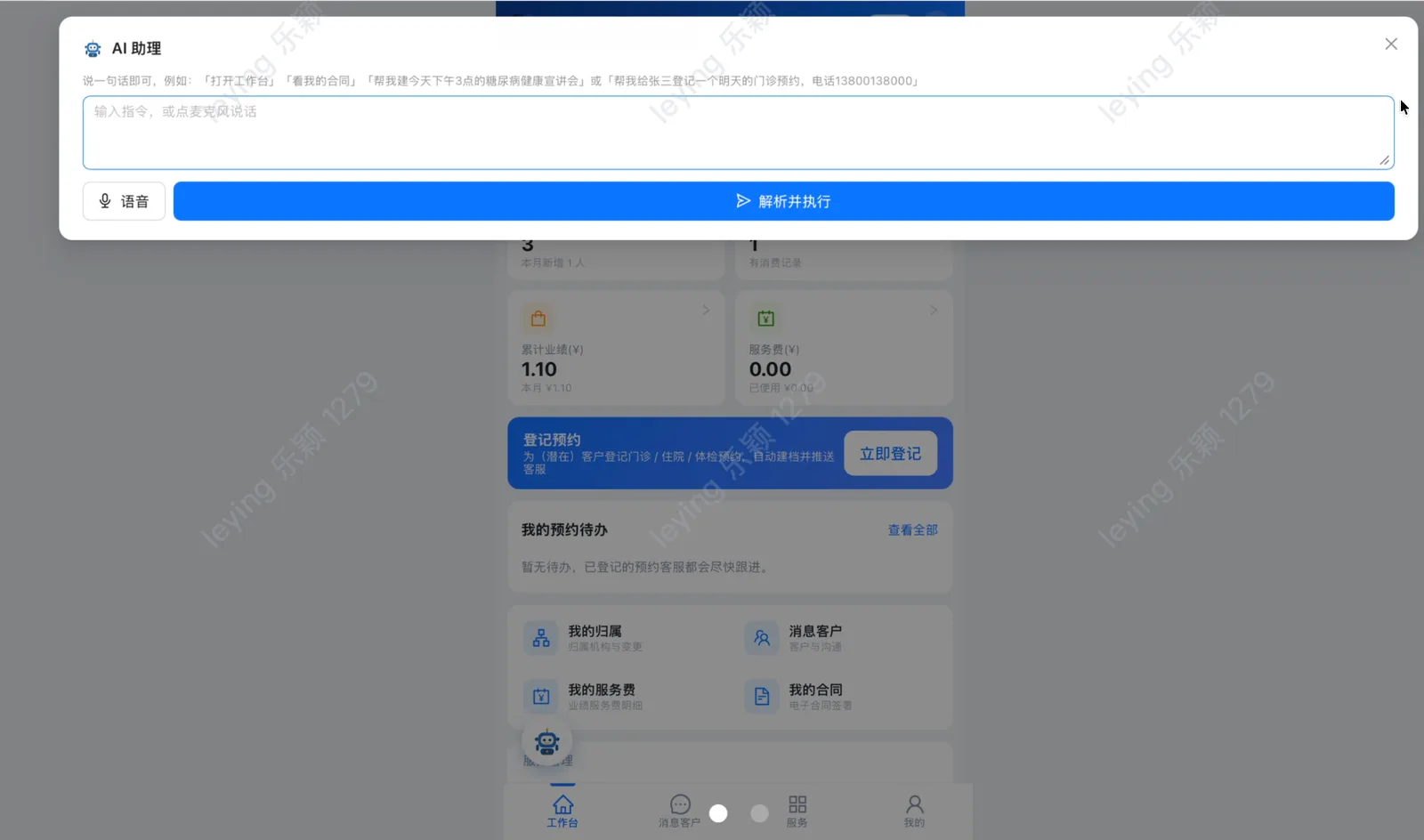
- An AI assistant for agents: an agent can create a seminar or register a customer’s appointment in one spoken or written sentence. The system parses the request and executes the action.
- Knowledge-base questions: the customer-service interface supports retrieval-augmented generation (RAG) over a knowledge base.
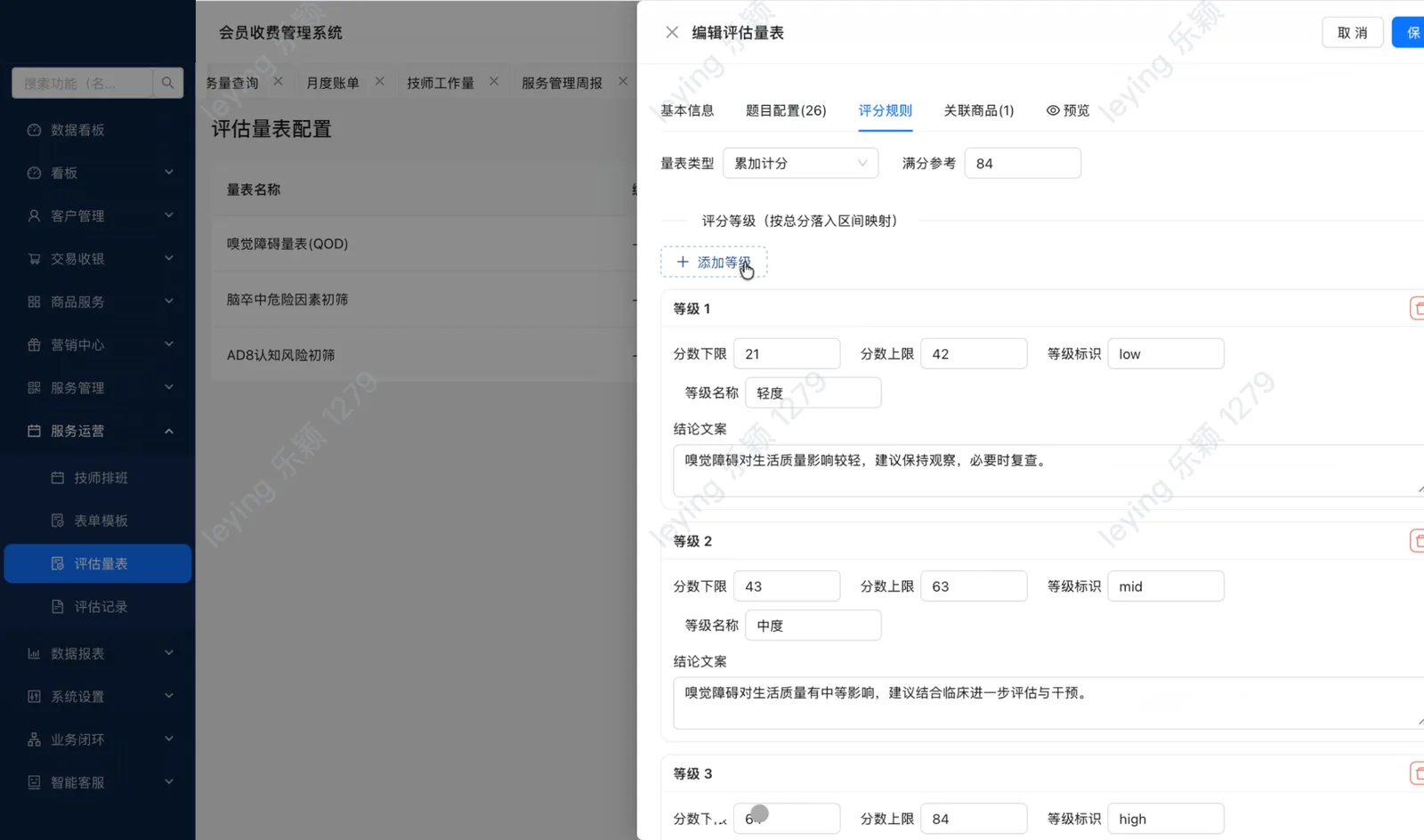
- Assessment questionnaires: departments define questions and scoring rules. Administrators configure score ranges, corresponding levels, and conclusion text. Questionnaires can be associated with products and sent automatically after purchase; customers complete them online and receive automatically calculated scores. Configured examples include QOD for olfactory dysfunction, preliminary stroke-risk-factor screening, and AD8 for preliminary cognitive-risk screening. Their clinical validation was outside the scope of this demonstration.
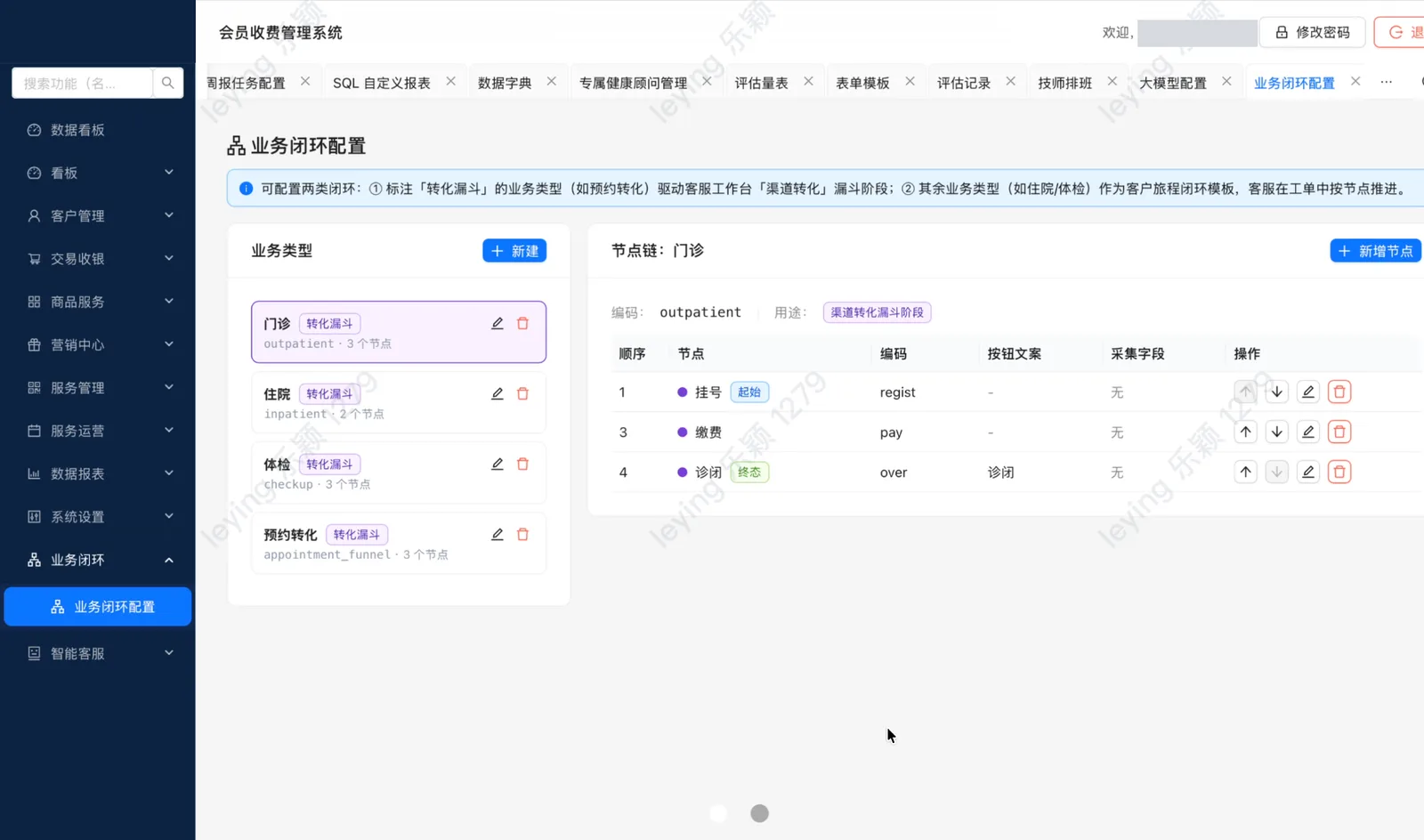
- Business workflow configuration: outpatient care, inpatient care, checkups, and appointment conversion each have their own sequence of steps, driving the service team’s conversion funnel and customer journeys.
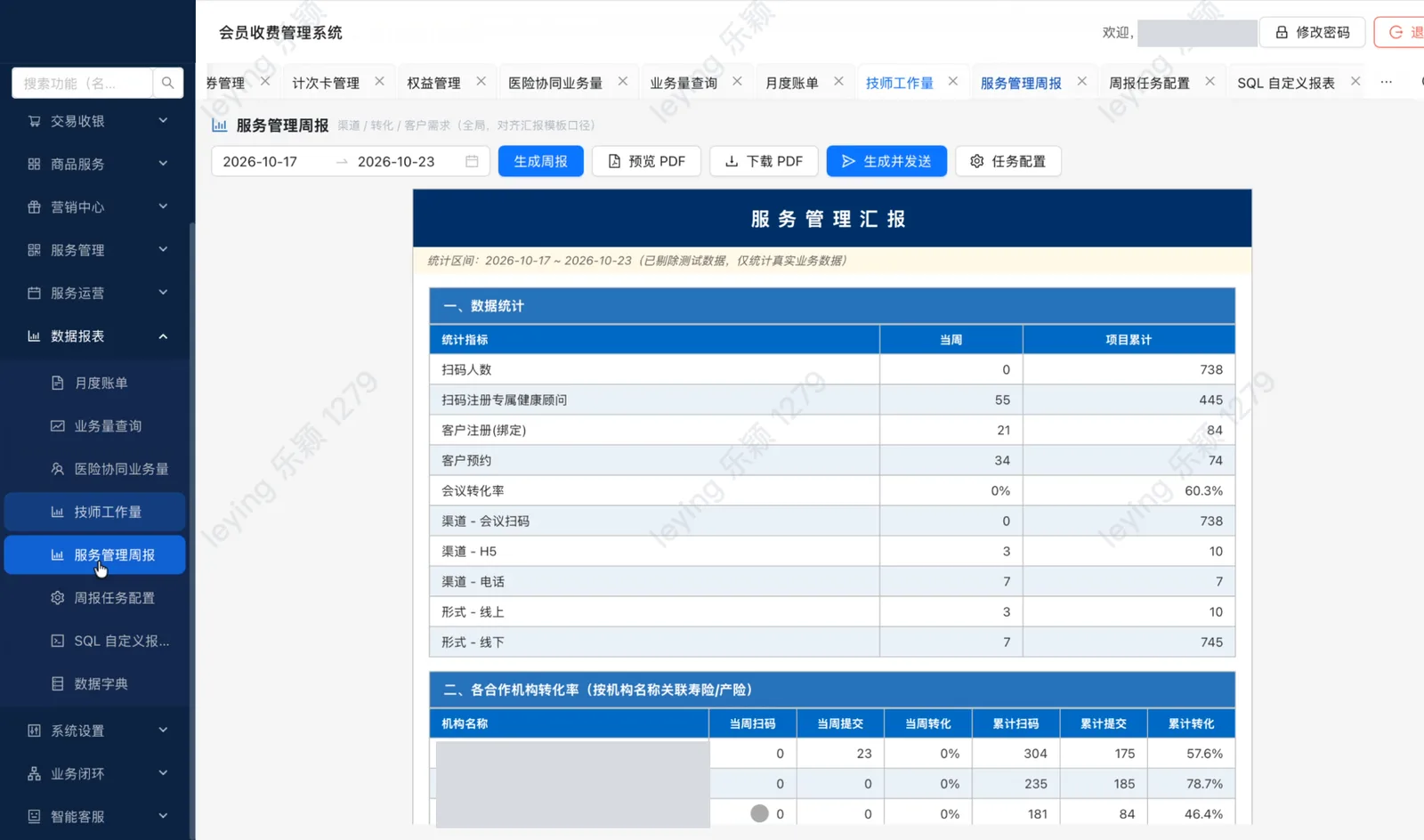
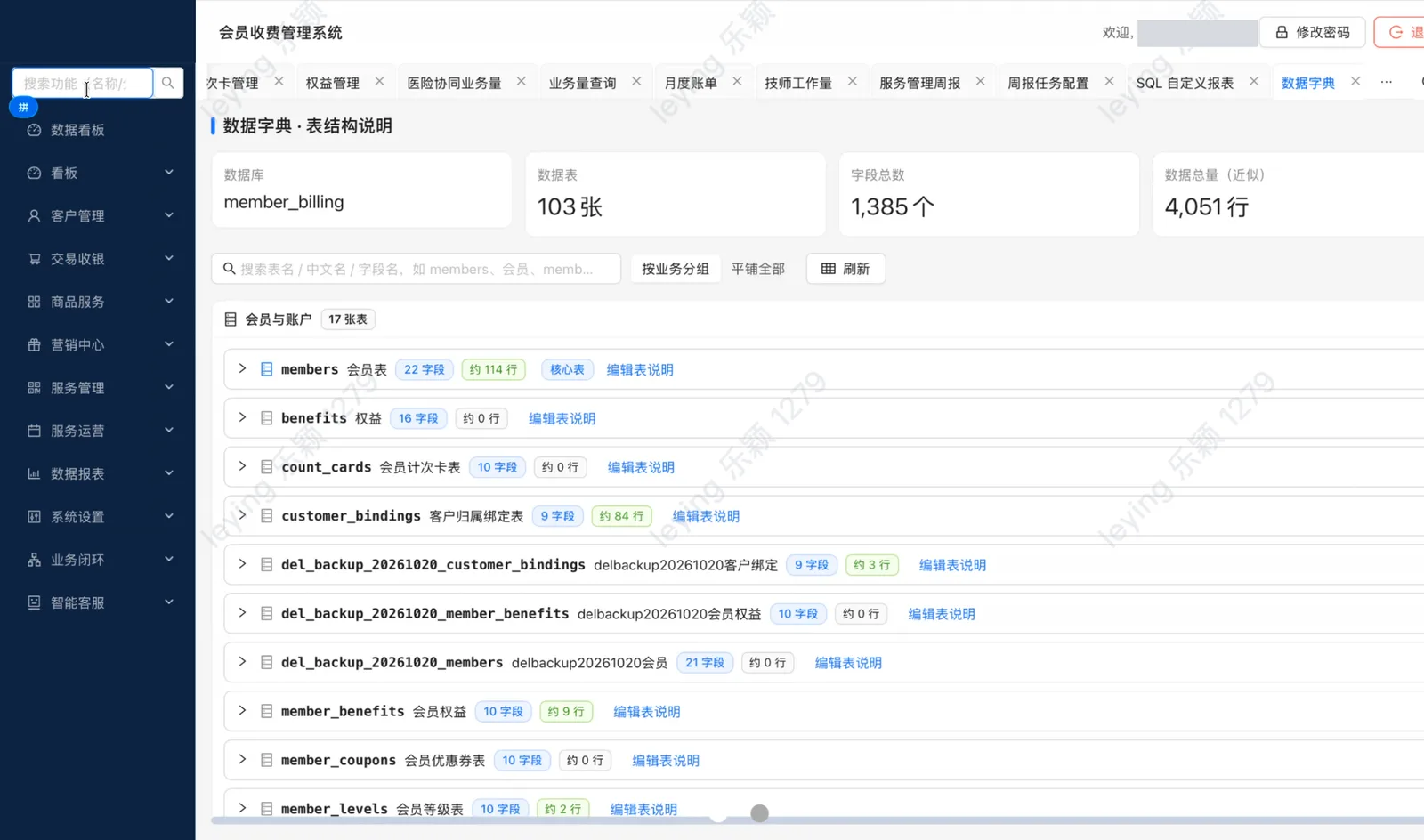
- The data foundation: weekly service-management reports automatically exclude test data and can be exported as PDF. A data dictionary documents 103 tables and 1,385 fields with Chinese descriptions. Custom SQL reports are read-only.
Working with the hospital: building while the system is in use
This is a system developed jointly with the hospital, without a single formal launch date. The mini program is available, some VIP-floor workflows are in use, referrals are being expanded, and customer service, pharmacy, and business-to-business workflows are still being completed.
The hospital supplies requirements and drives adoption internally. The FDE handles product design and development, judging whether each request addresses a real need and offers value. The hospital initially considered buying software. A standard medical-aesthetics billing and execution product was inexpensive, but its quotation rose into the millions of renminbi once local implementation was included. Another product investigated could not support local deployment and customization. The hospital ultimately chose to build, with the advantage that the system could evolve whenever a useful idea emerged.
| Module | Status on the demonstration date, October 23, 2026 |
|---|---|
| Mini program for agents and consumers | Available |
| VIP-floor billing, execution, and prepaid balances | Some workflows in use; transition incomplete |
| Agent referrals | Expanding; approximately 456–460 agents and 114 customers |
| Agent compensation | Rules designed; outpatient and inpatient settlement not yet formally processed in the system |
| Payment | WeChat Pay and prepaid balances in use; POS and other channels not fully connected |
| Customer service: telephony, transcription, and AI prompts | Technical debugging; not launched |
| Assessment questionnaires | Configuration capability complete |
| Pharmacy interface and nutritional products | In development |
| Business-to-business sales and benefit codes | Business process still being clarified |
The weekly report for October 17–23, 2026, with test data excluded, showed 445 personal health advisors registered through QR scans, 84 customer registrations linked to advisors, 74 customer bookings, and a seminar conversion rate of 60.3%.
Seven strengths
- Filling a gap outside conventional clinical systems: HIS and medical insurance cover catalogue-based care. This system covers service packages, prepaid balances, channels, and customer operations outside that catalogue. The systems complement one another.
- Calculating service fees backward from a package total: the billing model addresses one of the hardest accounting problems in consumer healthcare.
- Traceable acquisition: each order identifies who brought the customer, which seminar they joined through, and who organized it, providing a basis for performance attribution.
- Restrained but purposeful incentives: deduct drugs and consumables before calculating the 10% service fee, reduce the agent’s share across the first three visits, avoid easily exploited registration rewards, and offer hospital purchases with points at roughly half the cash price.
- Defining conversion as arrival: registrations alone do not stand in for business outcomes. Each step is recorded, exposing conversion and customer loss.
- Putting AI inside workflows: live transcription and privately deployed model prompts, one-sentence actions, and knowledge-base answers address specific frontline needs.
- Configuration and a data foundation: one FDE working for a month and a half compares favorably with the quoted millions of renminbi for localized commercial software.
The frontend can also be reused. The healthcare group’s medication-box offering could use the existing agent and sales layer for enterprise sales and distribution of benefit codes.
Next: demonstrate value with data
The next priority is to demonstrate value: how many people use the system each day, how many agents and consumers are active, and how much gross merchandise value (GMV) and revenue it brings. Registration counts are only a starting point.
- Complete the customer-service loop: validate and launch telephony so that referral → booking → callback → arrival becomes a working end-to-end process.
- Settlement and compliance: process agent compensation in the system, complete points withdrawals, and sign agent cooperation contracts.
- Business-to-business workflows and reuse: clarify enterprise group purchases, benefit codes, and related business processes.
- Requirements governance: establish clearer review and prioritization as the system expands.
One FDE and a month and a half moved a rehabilitation hospital’s consumer-healthcare operations from Excel to a system with products, channels, customer service, and data. In hospital IT, the most valuable system is often the one closest to the business and able to grow with it.